Introduction: Three AZs Is a Hardware Statement
We run in three availability zones is a sentence about where hardware sits. It says nothing about what fails when one of those zones goes dark, or what users see meanwhile. Most teams learn that distance on the worst possible day, when redundancy is intact on paper and absent in practice.
According to this secondary compilation of 2026 outages, at 05:53 UTC on 2026-10-20 a fault in an underground cable cut the power feed to the data centre hosting europe-west2-b, one of Google Cloud's three London zones. That is a secondary compilation, not a first-party postmortem from Google, so read each figure as its reporting. The building has two utility feeds, but the breaker for the second had been opened for repairs after a quarterly generator load test on 2026-10-14. The controllers that start the diesel generators, known as PLCs, act on undervoltage sensors wired upstream of the open breaker: they saw voltage on a feed that was not connected, checked no breaker position, and sent no start command. Batteries carried the load until they ran out; the zone's servers, network switches and local storage went dark.
As work failed over from europe-west2-b, demand and dependencies between the zones' control planes caused capacity shortages, API timeouts and HTTP 500 and 503 errors in the other two London zones, across Compute Engine, Kubernetes Engine, BigQuery, Cloud SQL and other products. One zone lost power; three zones served errors.
What follows is a design review of that gap, not an incident retelling.
Problem Overview: What a Redundancy Claim Actually Says
An availability zone is a physically separate failure domain inside a region: its own power entry, cooling and network fabric, far enough that a fire or a cable cut in one should not reach another. A region groups those zones behind a control plane that coordinates resources across them. That design is useful, and it is a narrow claim.
A redundancy claim has three parts, and only one is written down: placement, where the second copy lives; isolation, whether the failure can cross between copies; dependency, what they share. Multi-AZ addresses placement thoroughly. Isolation frays, because the zones share a control plane. Dependency breaks, because a managed database primary, a regional API that owns resource state, and the capacity that receives failover are shared by construction, and none appear in the sentence we run in three AZs.
So a zone is a failure domain for power, cooling and network hardware, not for the control plane that operates your resources, and not for the capacity that must accept them. Redundancy is also a state: two feeds with one breaker open is a design with one feed.
Technical Deep Dive: The Power Path and the Minutes It Bought
Data centre power is a chain, and each link is a place where design intent can fail to reach the load. Two utility feeds arrive from separate substations, so a cable fault should remove one. Each passes through a breaker into the building's distribution. A battery plant carries the critical load for a few minutes while diesel generators behind a transfer mechanism take over, driven by programmable logic controllers that read voltage sensors and issue a start command on undervoltage.
Read that as a system and 2026-10-20 stops being mysterious. The PLC logic acted on sensors wired upstream of the second feed's breaker. With that breaker open, they read live utility voltage on a feed that was not connected to the building. The PLCs saw no undervoltage, checked no breaker position, and sent no start command.
The controller measured the wrong side of a boundary, the classic instrumentation trap. Its model said both feeds were energised, true at the utility and false at the bus, and nothing required it to reconcile with the breaker's position. From 2026-10-14 until the fault the building was effectively single-fed, and nothing in the account suggests that raised an alarm.
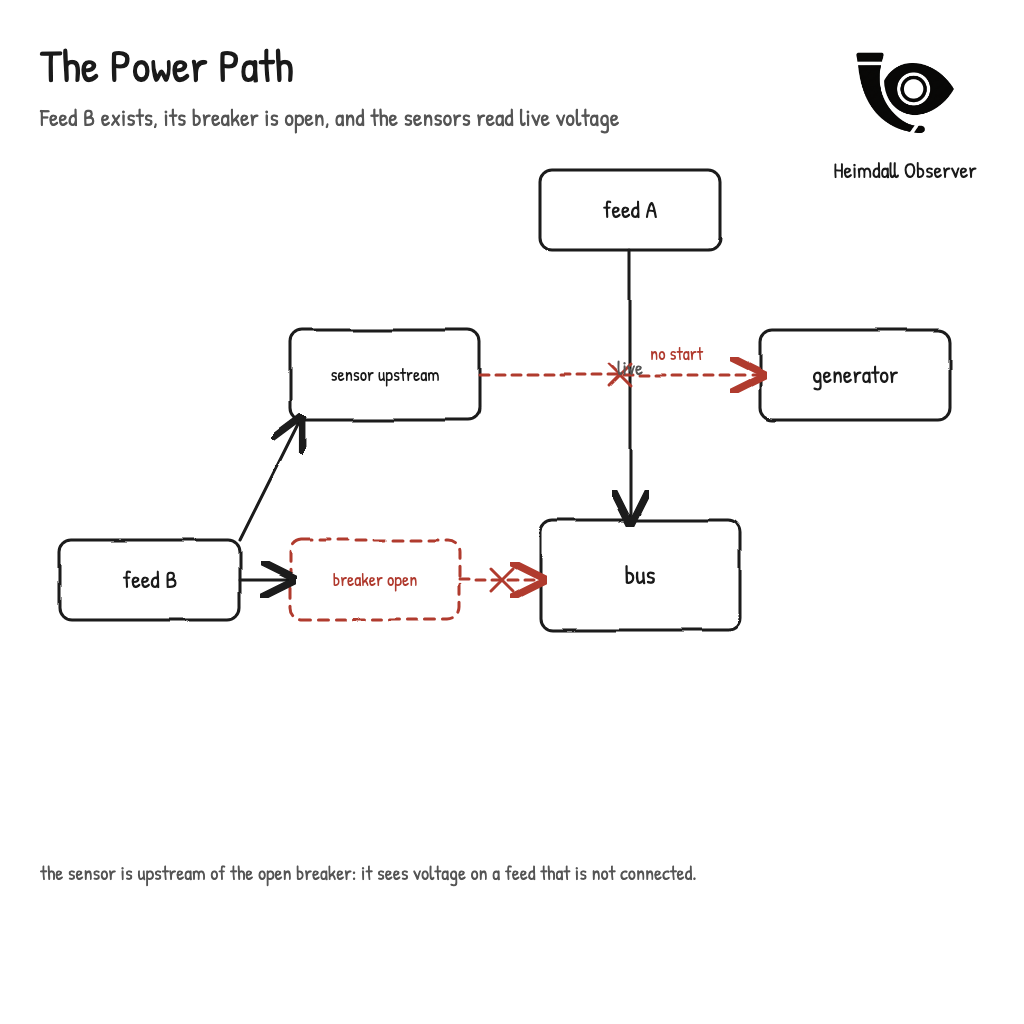
Figure 1: the power path for europe-west2-b. Feed B exists but its breaker is open, so sensors upstream of it read live voltage while the bus is unpowered and the start circuit never asserts.
The Minutes Batteries Actually Buy
Battery ride-through is sold as resilience. It is better described as a deadline: the batteries carried the load until they ran out, then servers, switches and local storage went dark together.
The timeline makes the conversion visible. The cable fault is at 05:53 UTC; the impact window the compilation attributes to Google runs from 06:00 to 12:08 UTC, 6 hours 8 minutes. Those few minutes separate the electrical event from the compute event, and they are the minutes in which the start command should have been issued. When it never comes, ride-through is a countdown.
The Cascade: How One Dark Zone Degraded Two Others
Failover is a transfer of load plus reconciliation work in the control plane, and the second half turned a zonal power failure into a regional service problem: as work failed over from europe-west2-b, demand and dependencies between the zones' control planes caused capacity shortages, API timeouts and HTTP 500 and 503 errors in the other two London zones, across Compute Engine, Kubernetes Engine, BigQuery, Cloud SQL and other products.
A regional control plane holds state that binds resources to zones, so when one zone stops answering, every object referencing it becomes work, and that burst lands on a service already busy. Capacity explains the rest: survivors held headroom for steady state, not for the whole region's working set arriving at once.
The third mechanism is yours: failover load as a failure mode of its own, since retries, health checks and autoscalers all react at the same moment.
The consequence worth internalising is that products which never ran a byte in europe-west2-b returned 500 and 503, because their control-plane paths depend on regional coordination, not on the failed zone. A zonal failure domain does not imply a zonal blast radius.
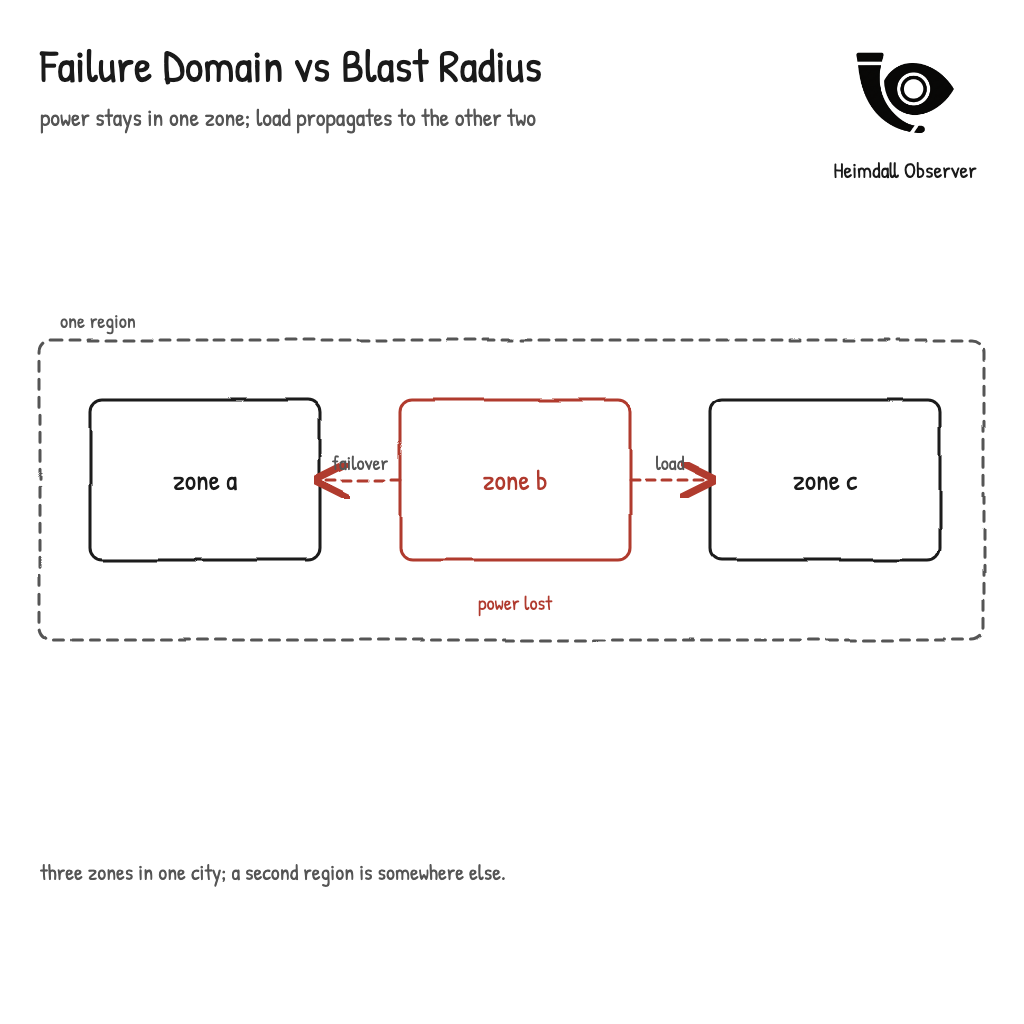
Figure 2: blast radius versus failure domain. Power loss stays in europe-west2-b, but reconciliation load, shared dependencies and failover demand propagate into the other two London zones.
Failure Modes: What Each Claim Promises and What It Delivers
Separating placement, isolation and dependency makes the redundancy vocabulary testable. This is the table I use in design reviews.
| Failure mode | Claim promises | Actually delivers | External check sees |
|---|---|---|---|
| Single instance loss | Health check replaces it | Seconds of drain errors | One endpoint failing briefly |
| Zone loss | Two zones absorb the traffic | Failover load plus reconciliation | One zone failing, siblings degraded |
| Region loss | Cutover to another region | Switch time, lag, cold caches | Whole region unreachable |
| Control-plane degradation | API parity with data plane | Timeouts, autoscaling stuck | Reads pass, writes fail |
| Cross-zone dependency | Zones are independent | Shared queue carries the failure | Errors in several zones at once |
Two rows get misread under pressure, and both were live on 2026-10-20. Zone loss and control-plane degradation each present as a partial regional outage, never as the runbook picture of one dark zone and two fine ones. The discriminator is shape, not count: errors in one zone are a zone problem, errors in every zone at once indicate a shared dependency, and errors on writes while reads pass point at the control plane.
Debugging Workflow: Separating a Zone Problem from a Dependency Problem
Run everything below from outside the region under suspicion. A dark zone returns nothing; a surviving zone returns its opinion, which during a cascade is usually the wrong one.
Step 1: Get the shape per zone with curl timing.
curl -sS -o /dev/null -w 'code=%{http_code} dns=%{time_namelookup} tcp=%{time_connect} tls=%{time_appconnect} ttfb=%{time_starttransfer} total=%{time_total}\n' --connect-timeout 5 --max-time 15 https://zone-a.example.com/healthzThe timings are the diagnosis: dns is resolution, tcp is path and listener, tls is trust, ttfb is think time. A zone where tcp never completes is not serving; tcp fast with huge ttfb serves badly; a 503 on fast tcp points at a dependency.
Step 2: Resolve per-zone and regional names with dig.
dig +short zone-a.example.com
dig +short zone-c.example.com
dig +noall +answer +ttlunits api.example.com
The point is not whether DNS works but whether you can pin a request to an address, so curl --resolve cannot drift onto a healthy zone and hide the failure. If a zone's name vanished while the regional name answers, you are looking at deregistration, not power.
Step 3: Separate path from host with mtr.
mtr -rwzc 100 -T -P 443 203.0.113.10
Flags: -r report, -w wide, -z AS numbers, -c 100 cycles, -T -P 443 for TCP. Loss from a hop onward is real; loss at one hop that vanishes at the next is rate limiting.
Step 4: Diff the provider status feed with jq.
curl -sS "$STATUS_FEED" | jq -r '.components[] | [.name, .status] | @tsv' | sort > "/tmp/status-$(date -u +%H%M).tsv"
diff /tmp/status-0850.tsv /tmp/status-0905.tsv
Run the first command on a one-minute loop. The filter flattens each component to name and status, so diff shows which moved and in what order, before any notice is published. Treat it as confirmation, never detection.
Step 5: Prove the zone is up while the dependency is not.
curl -sS -o /dev/null -w 'static=%{http_code} %{time_total}\n' --max-time 10 https://zone-a.example.com/assets/pixel.gif
curl -sS -o /dev/null -w 'txn=%{http_code} %{time_total}\n' --max-time 10 https://zone-a.example.com/api/checkout
A static asset exercises the edge and the network; a transactional endpoint exercises the database, the queue and any control-plane call. If the first is 200 and the second is 503 from the same hostname in the same second, the zone is healthy and the dependency is not.
Monitoring Strategy: Per-Zone Signals and the Reporting Gap
Thresholds are starting points. Granularity matters more than the numbers: every signal is per zone, because a region aggregate hides the event.
- Per-zone HTTP success from an external vantage point. One check per zone from outside the region; page when a zone falls below 99% across three consecutive 60-second checks. One dead zone in three is nearly invisible in a regional success rate.
- Cross-zone latency divergence. Alert when a zone's p95 exceeds twice its own seven-day baseline for five minutes. A cascade shows as divergence before errors.
- Error-rate attribution by zone. Alert separately on single-zone 5xx and on 5xx across two or more zones in one minute. One zone failing is local capacity; simultaneous failure is a shared dependency, where failover makes it worse.
- Redundancy state, not just failure. Alert when available feeds, zones or replicas drop below the designed count. On 2026-10-20 the second feed had been out since 2026-10-14; this fires days earlier, when acting is cheap.
- Status-feed change detection as a last resort. Diff the component feed every minute and route changes to the incident channel, not the pager: authoritative about the provider's view, useless about the first hour.
The Reporting Gap: What the First Hour Gives You
The compilation records that the first public status post went up about two and a half hours after impact began, and that a final report was published on 2026-11-04. For those hours nothing public named the zone, the scope or a recovery estimate. Confirming scope takes time, and a premature statement is worse than a late one, so the feed is confirmation, never detection, never a trigger for automated failover.
The human factor decides what happens next. A region aggregate gives the on-call a model with no visible boundary, which invites failing over into a control plane already reconciling a zone's worth of objects.
Best Practices: The Multi-Region Decision Framework
Multi-region is not a maturity badge; it is a purchase. Five conditions should hold before a team calls a deployment multi-region.
- Spare capacity exists in the second region continuously, sized for full production load and tested at it. Capacity you create during an incident needs the control plane under stress.
- The failover path does not traverse the failed region's control plane. If promotion needs an API call or state lookup there, the standby has a first-region dependency.
- Data has a measured replication lag and a stated recovery point, and promotion has been executed rather than documented.
- Traffic switching is yours end to end, with a measured switch time and a DNS provider you can change under pressure.
- Someone has run the whole thing at full load in the last quarter, in minutes you actually have.
The price is a doubled infrastructure floor, a second control plane to keep in sync, cross-region transfer, and a quarterly full-load test. If recovery objectives justify that, buy deliberately and test on schedule. If not, stay multi-AZ, write down what you accept, and instrument it: per-zone checks, headroom for a simultaneous transfer, and one rule of policy, that nobody fails over without confirming the target region from outside.
Frequently Asked Questions
Why did all three London zones have problems if only one lost power?
Because the zones share a control plane and the demand that arrives when one disappears. According to the secondary compilation of 2026 outages used here, as work failed over from europe-west2-b, demand and dependencies between the zones' control planes caused capacity shortages, API timeouts and HTTP 500 and 503 errors in the other two London zones.
Is multi-AZ enough for high availability?
It is enough for hardware failure, which is what it is designed for, and not enough for a control-plane event or a full simultaneous transfer at production scale. The test is not the diagram but the last time you moved all traffic into two zones while the control plane was busy.
How many external vantage points do I need per zone?
At least one per zone plus one outside the region, so a single failing vantage is not mistaken for a zone failure and a region-wide event cannot hide inside it.
What do I check first when I think one zone is down?
Per-zone curl timing, then a per-zone dig for an address to pin to, then mtr to that address. Finish with a static-asset and a transactional request against the same hostname: if the asset succeeds and the transaction fails, the zone is up and the shared dependency is not.
Conclusion
The lesson is not that cloud providers are unreliable. It is that availability-zone redundancy is a claim about hardware placement and power isolation, while what takes you down is a sensor reading the wrong side of a breaker, a redundancy state nobody alarmed on, and a control plane that cannot reconcile. All three are observable only from outside the failure domain, and only per zone.
Teams that want that view without operating a probe fleet use synthetic monitoring such as Heimdall to run HTTP, DNS and TCP checks from outside the region and assert on each zone separately, so a single dark zone never arrives disguised as a latency alert.