A technical analysis of how major companies still suffer devastating outages due to missed certificate renewals and internal monitoring gaps.


It is the most embarrassing outage an engineering team can face. Despite utilizing Kubernetes, distributed databases, and global CDNs, the entire multi-million dollar architecture halts abruptly because a $10 TLS certificate was not renewed.
In practice, this usually fails because organizations assume automation is infallible, or they rely on monitoring systems that lack external context.
In major incidents (such as those experienced by Epic Games, Spotify, and Microsoft), the root cause is rarely the public-facing website. The outage usually stems from a neglected internal API gateway, a legacy identity provider, or a machine-to-machine authentication endpoint.
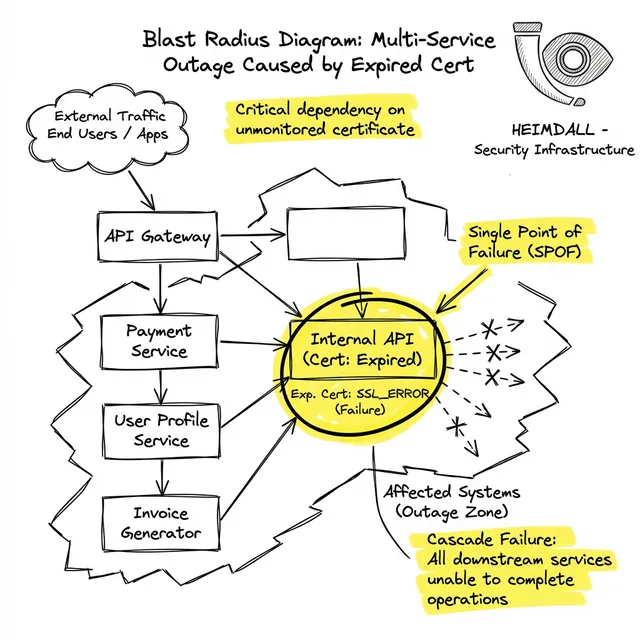
When the certificate on the Identity API expires, the frontend web servers fail to authenticate. The web servers throw 500 errors. Because the backend threw an error, the load balancers pull the web servers out of rotation. The entire system cascades into failure, and the on-call engineer gets paged for 'High 5xx Error Rate', not 'Certificate Expired'.
Why do these certificates get missed? Often, the CA sends 30, 15, and 3-day warning emails. However:
To prevent these postmortems, SRE teams must adopt a 'trust but verify' posture. Never rely on the system generating the certificate to also monitor the certificate.
Implementing an external, objective source of truth is non-negotiable. Heimdall Observer acts as this independent auditor. By decoupling the monitoring from your internal CI/CD pipelines, Heimdall provides clear, actionable alerts based on the actual cryptographic material being served to the network, ensuring an expired certificate never paralyzes your infrastructure again.
Join thousands of teams who rely on Heimdall to keep their websites and APIs online 24/7. Get started with our free plan today.
Start monitoring for free
Senior Systems Reliability Engineer focused on uptime, incident response, and building monitoring systems that surface problems before users notice.