
Introduction
Nothing in your repository changes during a DNS outage. No deploy goes out and the certificate is still valid. Your authoritative nameservers stop answering, and every resolver holding a copy keeps handing it out. That interval is your TTL; the outage is somebody else's incident.
It is the pattern the 2026 outage playbook documents across five layers: the failing system reports itself healthy. Caching makes it worse, because the failure arrives late and looks like nothing.
Authoritative DNS failover is not a TTL setting. A TTL is a cache duration — how long a resolver may reuse an answer it already has. It is not a statement that a second server exists when that answer expires. Failover requires another place to ask, already delegated and already answering, before the failure starts.
Problem Overview: Three Failures Share the Word DNS
A recursive resolver is a cache with a walker attached: on a miss it walks the delegation from the root, asks the authoritative servers named in each referral, caches the answer for the TTL, and returns it. Users talk to their resolver, not to you.
An authoritative nameserver holds the zone and answers from zone data with the Authoritative Answer flag set. It is findable only through the NS RRset the parent zone publishes; a resolver asks the registry, then asks the addresses it was handed.
One lookup crosses three failure domains: the resolver's cache, the authoritative servers and their provider's control plane, and the registry delegation. Only the middle one is yours; the third is the one teams forget, and this is where most monitoring setups have blind spots.
Clerk, 2026-02-10: The Provider Failed
At 17:06 UTC Clerk experienced an outage caused by a failure at its DNS provider. Authoritative DNS resolution for Clerk's APIs was unavailable for 2 hours and 32 minutes. Clerk had no failover prepared for a complete provider outage; redundancy was planned for 2026 but ranked below other infrastructure improvements.
Quad9, 2026-05-08: The Zone, Not the Resolver
On 2026-05-08 Quad9's primary zone quad9.net experienced an outage of about 40 minutes. A failed validation step between Quad9's primary hidden authoritative servers and PCH's anycast network caused it, produced by legacy zone transfer configuration that was not correctly documented and was inadvertently modified during maintenance.
Control D, 2026-10-11: Every Location, Every Protocol
From 16:40 to 17:35 UTC on 2026-10-11, about 54 minutes, Control D's DNS service for paying customers stopped answering queries at every location, on every protocol including DNS-over-HTTPS and DNS-over-TLS. The free service stayed online; no query was answered incorrectly and no customer data was changed or exposed.
What "95% of Expected" Proves, and What It Does Not
Successful request volume to Clerk's APIs stayed above 95% of expected during the outage, due to DNS caching, fallback DNS servers and emergency guidance. That describes clients with a cached answer or a fallback resolver — not cold resolvers, first visits, or short TTLs. And because the figure held for 2 hours and 32 minutes, that remainder existed for the whole window.
Technical Deep Dive: The TTL Budget
Caching is a budget you spend down, not a state you are in. Each resolver holding your record has cover in seconds, bought at its last successful fetch. The outage consumes it; at zero the resolver must ask again, and nobody is left.
The Delegation TTL Is Not Yours to Set
The NS RRset pointing at your nameservers lives in the parent zone, with a TTL published by the registry. Editing your record TTLs does not change how fast a resolver re-checks that delegation.
Resolver Policy: Caps, Floors and Stale Answers
Your TTL is a suggestion resolvers honor within their own policy. BIND's max-cache-ttl and Unbound's cache-max-ttl cap how long a record may live regardless of what you published, while cache-min-ttl floors keep answers longer than asked.
Two mechanisms bend the curve without removing the dependency. Negative caching (RFC 2308) lets resolvers remember NXDOMAIN and NODATA from the SOA minimum, so a mistaken negative answer can outlive the mistake. Serve-stale (RFC 8767) can extend that window at the resolver operator's discretion. Neither is a contract.
Doing the Arithmetic for a Real Outage
The Clerk outage lasted 9,120 seconds. With a 300-second TTL and an average refresh near the midpoint, a typical resolver holds about 150 seconds of cover once the authority goes dark — a few percent of the exposure, removed when nobody is watching.
At 3,600 seconds the shape improves without changing: an hour of cover, then a cliff. The failure is not eliminated, it is scheduled, and it ramps rather than steps because resolvers expire continuously.
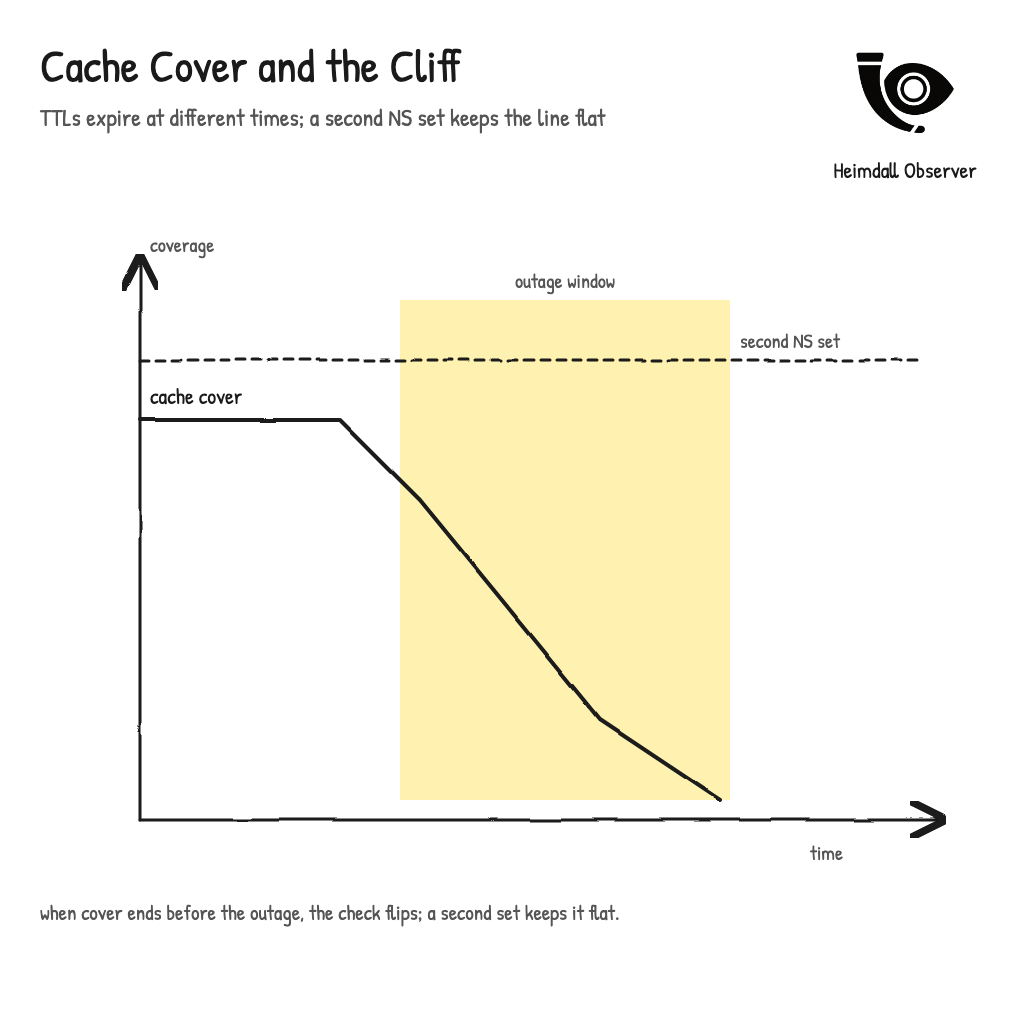
Figure 1: cache lifetime plotted against the outage window. TTLs expire at different times across the resolver population and the failure ramps, while a second delegated nameserver set keeps the curve flat.
A TTL reduces the rate at which resolvers need your authority, not the number of clients that eventually need it. For choosing the number, see DNS TTL best practices; this article covers what happens after the timer runs out.
Failure Modes: What Absorbs What
Four failure types hide inside "DNS problems", each with different absorption and first signal.
| Failure type | Expected user impact | What absorbs it | First signal that reveals it |
|---|---|---|---|
| Edge or propagation issue | Brief inconsistency, some resolvers serve old data | The resolver cache: the stale answer is still valid | Divergent answers across resolvers |
| Partial authoritative failure | Most queries succeed, a slice of clients time out | Remaining nameserver IPs, if the resolver tries another | Per-IP failure while website checks look normal |
| Total authoritative outage | Cached answers work until expiry, then SERVFAIL | Nothing, unless a second delegated provider exists | Fresh-label resolution fails, resolvers return SERVFAIL |
| Zone transfer or validation failure | Zone data stops updating, or signatures are rejected | A correct secondary, or a resolver treating it as unsigned | SOA serial stops advancing, SERVFAIL at validators |
The Registrar Trap
Delegation changes are registry operations mediated by your registrar. If the registrar's control plane sits in the same failure domain as your DNS provider, your escape hatch is inside the burning building. Clerk discovered that one critical domain used the same provider as its registrar, which prevented emergency nameserver changes during the outage.
The trap is structural: the fix is an NS update at the registry, and the credentials, API and dashboard all depend on the failing provider. Test that path before you need it.
The Stagger Gap
Control D shows the asymmetry precisely: software updates were rolled out gradually, but configuration changes were not staged. A 2026-09-16 API update began saving an optional per-domain override as an integer while the DNS software expected a string. The first save of that kind, on 2026-10-11, reached every DNS server for paid plans at the same moment, and an error-handling flaw made the software stop instead of logging and skipping the unreadable value.
The first automated alerts at 16:46 reported individual servers and locations failing; none said that DNS for paying customers was down. No sum of per-server alerts produces a service-level statement.
Debugging Workflow: From "DNS Looks Broken" to the Exact Branch
The goal is to place the failure in one of five locations: resolver cache, recursive resolver, authoritative nameserver, registry delegation, or registration state. Each branch has one command that confirms it.
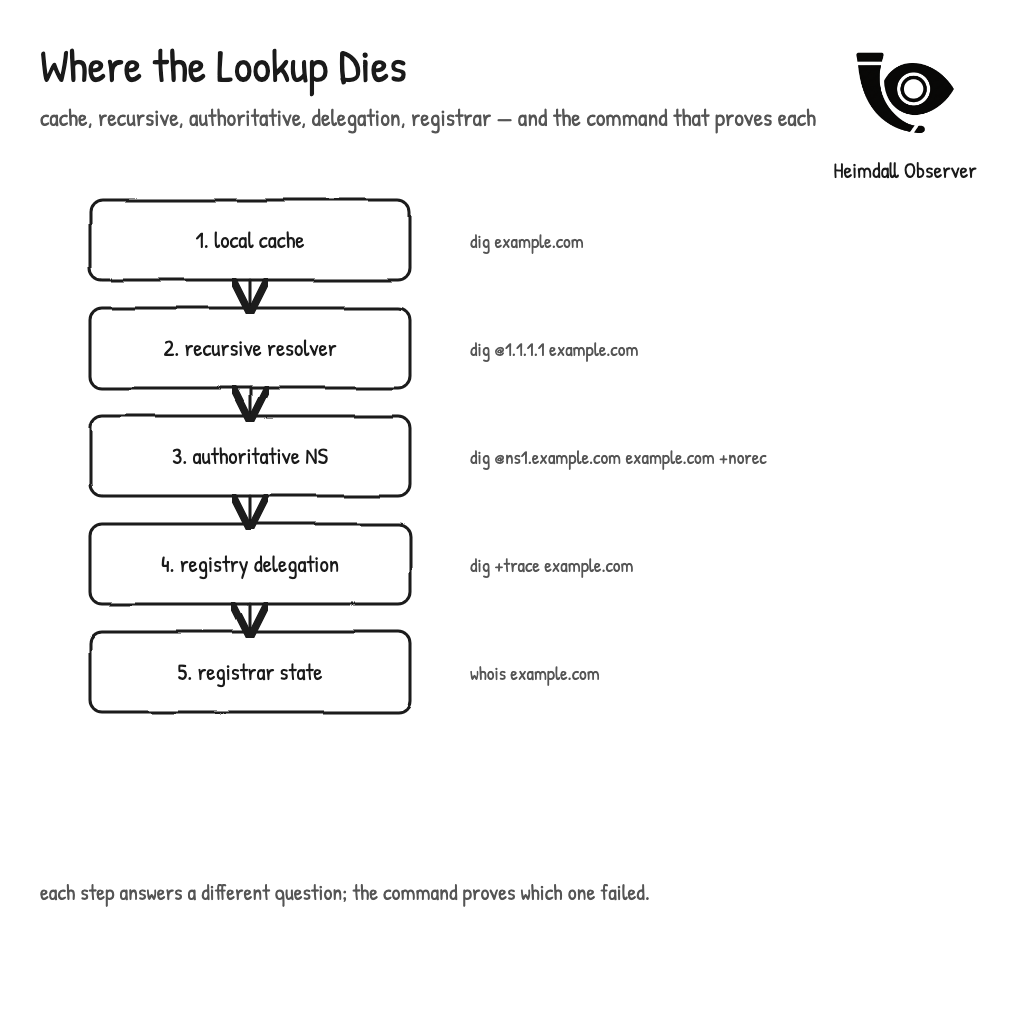
Figure 2: decision tree for a failing lookup — cache, recursive resolver, authoritative nameservers, registry delegation, registrar state — with the confirming command for each.
A cold trace shows which servers the hierarchy hands out and where the walk stops.
dig +trace example.com A
Answers from your nameservers mean the delegation is intact, so the fault is closer to the client. A stop after the parent's referral means the delegated addresses are unreachable or refusing.
Ask each authoritative address directly, without recursion. This separates partial from total failure — the step most runbooks skip.
dig +norec +time=2 +tries=1 @ns1.example.net example.com A
dig +norec +time=2 +tries=1 @ns2.example.net example.com A
Expect status NOERROR, the aa flag, and the record in the answer section. With +norec your local resolver cannot answer from cache, so a result is the server speaking for itself. One address timing out while another answers is a partial failure, and an empty answer is still informative: the authority section carries either a referral's NS RRset or the zone's SOA.
Next, read the resolver view: divergent status codes across public resolvers mean a stale or invalid zone rather than a dead one.
dig @1.1.1.1 example.com A
dig @9.9.9.9 example.com A
SERVFAIL from both while the +norec queries succeed means the zone answers but resolvers reject it: compare SOA serials, and if signed, suspect validation. Timeouts everywhere, with +norec also failing, means you are in an incident.
for ns in ns1.example.net ns2.example.net; do dig +short @"$ns" example.com SOA; done
Identical serials mean the zone is consistent; a lagging one means a transfer problem. A withdrawn anycast prefix looks different again — servers healthy, path not — which is the distinction in the full breakdown of BGP path hunting.
Finally, prove HTTP and TLS are fine. If the origin answers when you supply the address, DNS is the only broken layer.
curl --resolve "example.com:443:203.0.113.10" -sS -o /dev/null -w "%{http_code} %{time_total} %{remote_ip}" https://example.comA 200 with a failing dig is a complete diagnosis: up, and unreachable by name. To compare what two resolvers return without reading dig output, reduce both with jq.
for r in 1.1.1.1 9.9.9.9; do
  dig @"$r" example.com A +short | jq -R -s --arg r "$r" '{resolver: $r, answers: (split("\n") | map(select(length > 0)))}'
done
An empty answers array from one resolver and a populated one from the other is the cleanest evidence that the resolver population is split, which is what a partially expired cache looks like. A broader walkthrough is in how to debug DNS resolution problems.
Monitoring Strategy: Signals a Cache Cannot Satisfy
None of these can be answered from a cache. Thresholds are starting points to tune against your baseline.
| Signal | What it proves | Starting threshold |
|---|---|---|
| Authoritative reachability per NS IP, queried with +norec from three or more networks | Each server answers for itself | Two consecutive failures on any IP |
| Fresh-label resolution through a wildcard probe record | Resolvers consult your authority, not a cache | First failure |
| Apex resolution from several public resolvers | The resolver population can get an answer | Any non-NOERROR twice in a row |
| SERVFAIL rate at a validating resolver, against a control zone | Signatures and delegation still validate | Above 1% of probes over five minutes |
| Delegation drift: parent NS RRset versus intended set | The registry still points where you think | Any difference, checked daily |
The per-IP row earns its strictness from UDP's nature: two consecutive misses on two independent networks is not packet loss. The fresh-label row is the cheapest signal most teams lack: a wildcard probe subdomain lets you query a name nobody has requested, forcing a full walk to your authority every check. Tools that support it are compared in the DNS monitoring tooling roundup.
A website check cannot substitute, and Clerk named the mechanism: its alerting tools did not explicitly check the uptime of authoritative nameservers, and its uptime checks benefited from long TTLs. An HTTP check every five minutes behind a resolver caching beyond the 2 hours and 32 minutes of the outage keeps passing throughout; at a one-hour TTL it would have gone red at the one-hour mark. The monitor was not lying; it answered a different question.
Read the signals together. Fresh-label failure with healthy per-IP answers means the delegation is wrong; healthy fresh-label resolution with rising SERVFAIL means validation. Both failing at once means a total outage.
Best Practices: The Pre-Outage Checklist
- Delegate two providers before you need them, and verify the delegation, not the contract. Both NS sets must appear in the parent zone and hold the same data; test each address with +norec.
- Decouple the registrar from the DNS provider: separate control plane, credentials outside that provider's SSO, and one rehearsed NS change a year.
- Keep record TTLs short for migration agility, but stop treating that number as failover capacity; the parent's NS TTL is outside your control.
- Assert the service, not the server. One alert naming the zone and the failing vantage points beats two hundred per-server alerts.
- Stage configuration changes with the discipline you apply to code, and make parsing fail open. Control D's error handler turned one unreadable value into a total stop.
- List the DNS provider as a named dependency with a total-outage plan; Clerk's redundancy was planned for 2026 but ranked below other improvements.
FAQ: Authoritative DNS Failover Questions Engineers Actually Ask
Does lowering my TTL prevent a DNS provider outage from taking my site down?
No. It shortens how long a resolver answers from cache, so the failure reaches new lookups sooner. Failover needs a second nameserver set already delegated in the parent zone, not a smaller number in your zone file.
What happens when every authoritative nameserver for my zone stops answering?
Resolvers serve cached answers until each TTL expires, then return SERVFAIL or time out. A warm cache hides the outage; a cold lookup fails immediately.
Is a second DNS provider automatically a failover?
Only if its nameservers are in the delegation at the registry and hold current zone data. A second account, or NS records inside your own zone, creates no path a resolver can take.
Why did my uptime monitor stay green during a DNS outage?
Because it resolves once and caches: it learns of the outage only when its cached answer expires, and stays green throughout only if that window outlasts the outage. Nameserver uptime needs its own check.
Conclusion
The TTL myth survives because it is almost true: caching really does absorb the first minutes or hours of an authoritative outage, which is why the graph looks fine and the postmortem reads as a surprise. What caching cannot do is create a second place to ask. That has to exist in the delegation, be verified from outside, and monitored as its own layer.
The other failure shapes in the 2026 outage playbook follow the same rule — the owning system reports healthy while the external path is broken. Teams that want that layer covered can run per-nameserver authoritative probes and fresh-label resolution checks alongside a plain HTTP check, which is what Heimdall's DNS monitors do.