
Introduction
According to this secondary compilation of 2026 outages, on the evening of 2026-05-05 DENIC, the registry for .de, performed a routine DNSSEC key rollover. That account is the compilation's, not a first-party postmortem from the operator; the timestamps and counts below are the ones it records.
Most teams file DNSSEC under a per-domain decision: publish DS records at the parent, or do not, and the blast radius stops at your zone boundary. That rollover is the counterexample. Names stopped resolving for users whose domains had never been signed at all.
The cryptography is interesting; the operations are the lesson. Three testing and validation tools detected the errors as intended, but the generated notifications were not processed correctly. Detection happened; delivery did not.
Problem Overview: The Chain Your Uptime Inherits
A validating resolver does not trust your nameservers, it trusts a chain. From a root trust anchor it walks down: the parent publishes a DS record holding a digest of the child's key signing key, the child publishes its DNSKEY RRset, and each signed RRset carries an RRSIG. RFC 4033 to 4035 define the mechanics; RFC 6781 the order of a key change.
Two fields carry the load. The DS says which key to expect. The RRSIG carries a key tag — 16 bits derived from the DNSKEY RDATA, RFC 4034 Appendix B — naming the key that signed, and the resolver verifies against the DNSKEY holding that tag. The design assumes one key per tag. When three share it, the tag stops identifying and starts guessing.
The outcome surfaces as a status code: a completed chain sets AD, a broken one returns SERVFAIL.
Then the part teams miss. An unsigned child still depends on the parent's signatures: the NS RRset pointing at the child's nameservers is signed by the parent, and so is the authenticated denial proving the child has no DS. Break the parent and the unsigned child stops resolving: the proof of its unsigned state cannot be verified. DNSSEC is opt-in per zone and opt-out of nothing.
Technical Deep Dive: What a Rollover Owes the Chain
A rollover is a sequencing problem, not a generation problem: the work is publishing a key so that no resolver validates against something it has not seen.
The Four Moves, and the TTLs Between Them
In the pre-publish approach of RFC 6781 you publish the new DNSKEY beside the old, wait out the DNSKEY RRset TTL, sign with the new key while the old signature is still valid, and retire the old key after another TTL wait. A key signing key rollover adds a parent step: publish, wait, swap the DS, wait out the DS TTL, remove the old key.
Four things break: the published key set is not the set the operator believes; the DS points at a withdrawn key; the RRSIG expires because nobody re-signed; or the tag no longer identifies one key. The first three are timing. The fourth is structural, and it is the one that happened.
Where the HSM Boundary Enters
A hardware security module is a tamper-resistant device that holds private keys and signs internally; material never leaves in usable form. That boundary forces a choice: one pair loaded into every device, which needs an export or a ceremony, or one pair generated inside each and exported to nothing.
The compilation records the second: "Its in-house rollover agent generated a separate key pair for each hardware security module instead of one pair loaded into all of them, all three under the same key tag, 33834." Three devices, three key pairs, one published identifier. The compilation does not say how the tag came to be shared, and this article will not guess; what it records is the state resolvers were handed.
Why Only a Third of Signatures Validated
Verification is a lookup then a check. The resolver reads the tag from the RRSIG, finds the DNSKEY with that tag and algorithm, and verifies. With three public keys under one tag the lookup returns candidates, not a key: verification succeeds only when the selected candidate is the one that signed.
The compilation reports that only about a third of signatures could be validated. Three keys competing for one identifier produces that ratio, and it explains why the failure looked partial — a resolver that picked right accepted the answer and its user saw nothing.
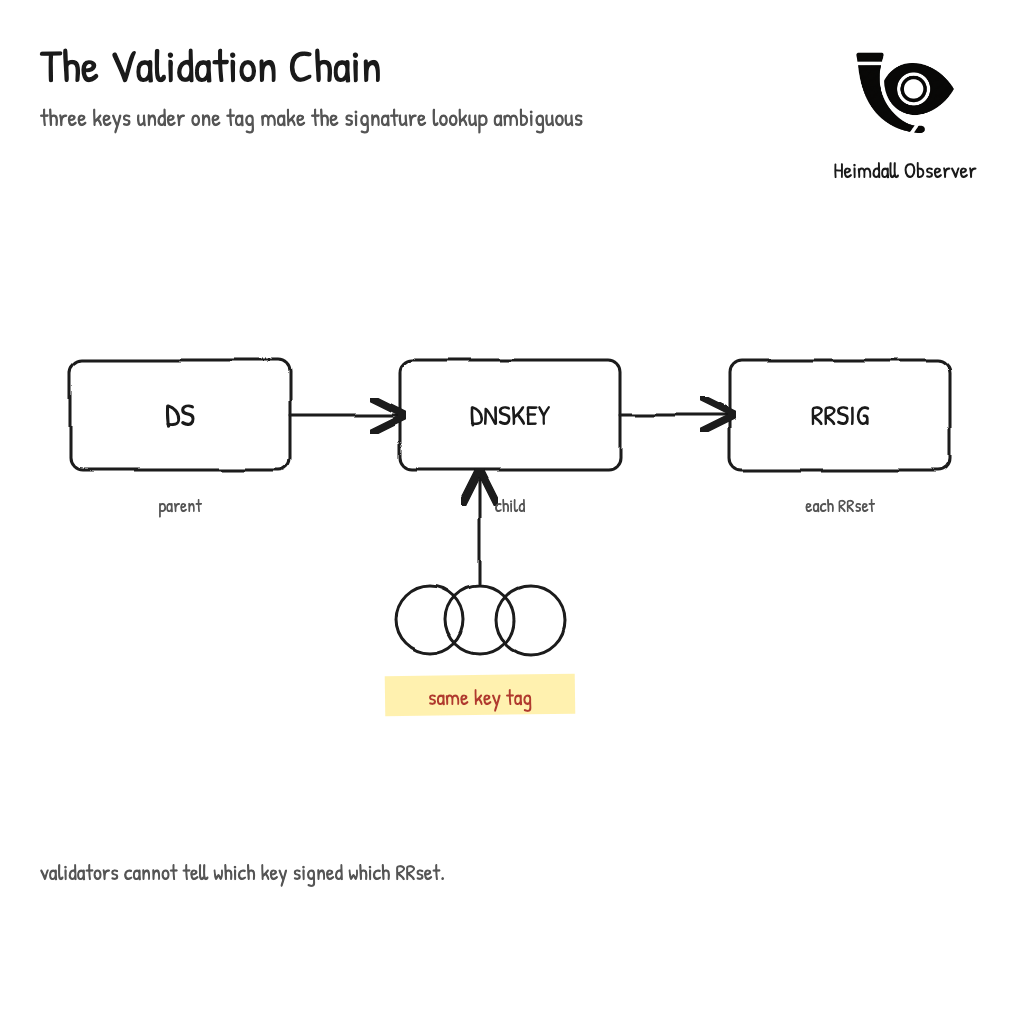
Figure 1: the validation chain from the parent's DS record through the child's DNSKEY set to the RRSIG on each RRset, marking where three keys under one tag make the RRSIG lookup ambiguous.
Failure Modes: What the User Actually Sees
A Signature the Resolver Cannot Verify
When DNSKEY validation fails, a strict validator returns SERVFAIL. The user gets no certificate warning, because TLS was never reached — the name did not resolve. The symptom is "site cannot be reached" or a stale page, which is why it gets reported as "DNS is down" to the wrong team.
The Restore Path: Treating a Zone as Unsigned
The compilation records the recovery that mattered: "Cloudflare saw the incorrect signatures from about 19:30 UTC and restored .de on its public resolver at 22:17 UTC by treating the zone as unsigned." Just under three hours, consistent with the roughly three-hour outage it records.
That is a deliberate downgrade: the resolver stops requiring a valid chain and accepts data unvalidated. It is the right call when the alternative is that every .de name fails, and it is taken per zone, on somebody else's schedule. Your recovery time may be set by a third party's willingness to disable validation.
Detection Without Delivery
The sentence to paste into your runbook: "Three testing and validation tools detected the errors as intended, but the generated notifications were not processed correctly." The tools worked; the chain to a human did not.
That chain has five links. Owner: a rule exists but nobody is named. Route: the alert lands in a channel read in business hours. Dedupe: a sustained condition suppresses itself, so a long outage goes invisible. Severity: it fires at informational and never pages. Channel: the webhook returns 404, the room was archived, the alias forwards to someone who left. The compilation does not say which link failed, and from outside a broken chain and a missing detector look identical.
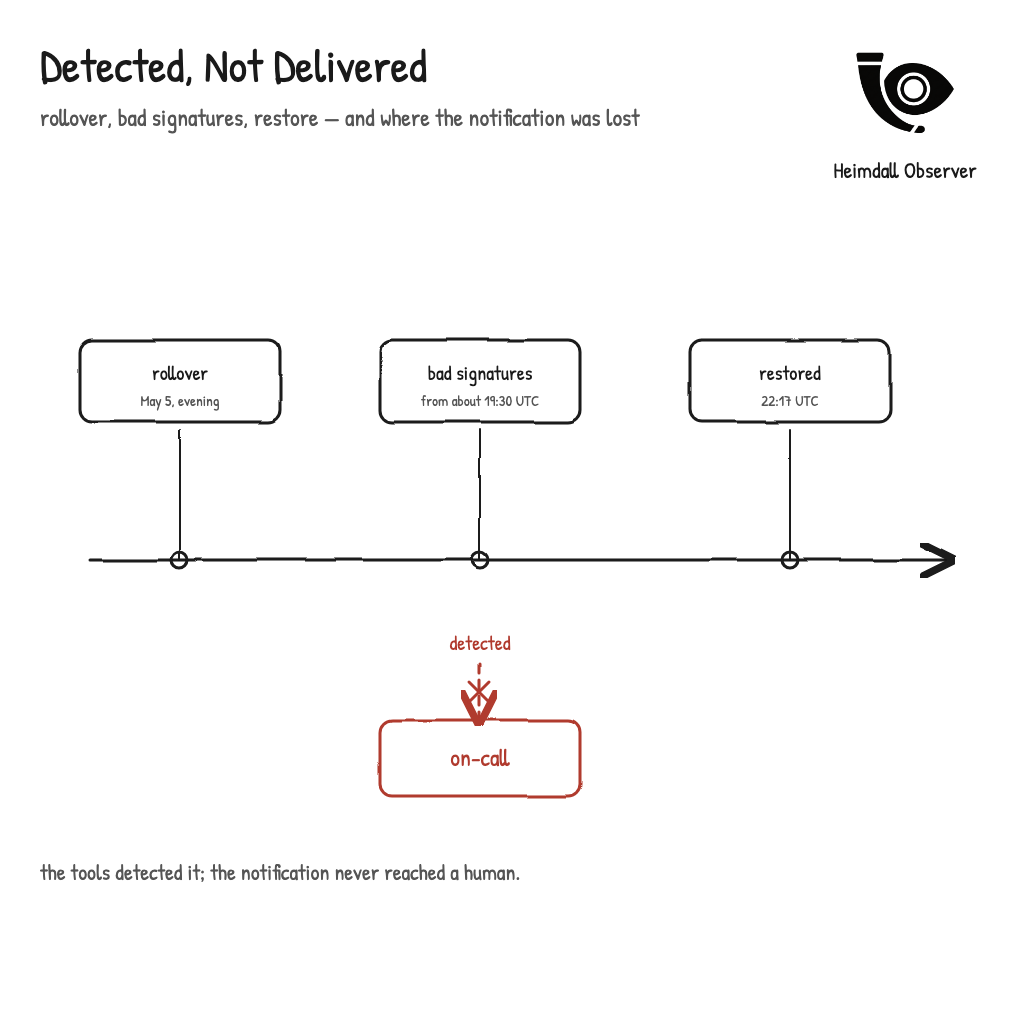
Figure 2: the 2026-05-05 timeline — rollover, incorrect signatures from about 19:30 UTC, .de restored at 22:17 UTC — with detection marked where it happened and the notification marked where it was lost.
Six failure modes, three vantage points.
| Failure mode | Signer-visible symptom | Resolver-visible symptom | User-visible symptom |
|---|---|---|---|
| Bad signature after rollover | Signing succeeded, RRSIGs present | SERVFAIL; data present with CD | Name does not resolve |
| Missing DS at parent | DNSKEY published, nothing at the parent | Zone insecure, AD never set | Works, unvalidated |
| Expired RRSIG | No re-signing; zone file looks normal | SERVFAIL after expiry | Outage starting at a printed timestamp |
| Key tag collision across HSMs | Key count matches HSM count | Ambiguous lookup, per-query result | Some users fine, some not |
| HSM distribution error | Each device holds a key; set unchecked | Published set differs from the plan | Same as bad signature |
| Zone treated as unsigned | No signal at all | Validation disabled, AD absent | Resolution restored, trust removed |
Debugging Workflow: Signature, No Chain, or Something Else
The question is narrow: is the name failing because the resolver cannot prove the signature, because there is no chain, or because something else broke?
Start at the parent, because that decides whether validation was ever possible. Run this in bash:
dig +short DS example.de @1.1.1.1
An empty answer means the delegation is insecure: no signature problem can explain an outage for that name, so stop looking at DNSSEC. A digest means a chain exists and the resolver had something to validate.
Next, read what a validating resolver concluded:
dig +dnssec example.de A
Check the status and the flags line. A validator that completed the chain sets ad; one that could not returns SERVFAIL. NOERROR without ad usually means an insecure zone, which sends you back to the DS check.
Then bypass validation and ask the same question — the most useful comparison in DNSSEC debugging:
dig +cd example.de A
The CD bit tells the resolver not to enforce validation. If this returns the record while the +dnssec query returns SERVFAIL, the data exists and the proof is what failed. That separates "unreachable" from "unverifiable" — different owners.
Now inspect the published key set, against an authoritative server so nothing comes from cache:
dig +short DNSKEY example.de @ns1.example.de
One base64 blob per published key, so the count is the first thing to check: three entries where the plan said one, or a count that does not match the HSMs you believe are signing. Make the shape unmissable:
dig +short DNSKEY example.de @ns1.example.de | wc -l
Finally, validate explicitly and read the chain, not the verdict. delv validates itself and traces the key ids it considered:
delv @1.1.1.1 example.de A +rtrace
If different RRSIGs are attributed to one key id, or one id maps to more than one candidate DNSKEY, you have a tag collision. If the trace stops before the DNSKEY lookup, the DS is missing or mismatched.
Last, prove the resolver is healthy rather than the zone. Plain dig against a zone you know is signed shows status and flags:
dig example.com A
If the control sets ad and your zone does not, the zone is the problem. If neither does, stop debugging DNSSEC and look at the resolver.
Monitoring Strategy: Signals That Survive a Bad Signature
Every signal has to be collected outside the signer. A monitor that asks the signer whether signing worked reports success through the whole outage, because the signer did sign. Thresholds are starting points to tune.
| Signal | What it proves | Starting threshold |
|---|---|---|
| Validated resolution of one name per zone, from three or more resolvers you do not operate | The chain completes somewhere other than your resolver | Two consecutive SERVFAIL from any vantage |
| AD-bit presence on a signed zone | Validation finished end to end, not just an answer arriving | Any sustained drop below full presence |
| SERVFAIL delta against a control zone | A broken zone, not a broken resolver | Above one point absolute in five minutes |
| DNSKEY count and distinct tag count | The published key shape, where rollovers fail silently | Any change outside a declared window, or a duplicate tag |
| Synthetic alert requiring acknowledgement | The delivery path, which detection does not test | No acknowledgement in fifteen minutes |
The first two rows share a rationale: your resolver's answer is not your users' answer. Dashboards, logs and error rates sit behind the same resolution step, so when the chain breaks they go quiet together. An alert on your 5xx rate cannot fire when the name carrying the request does not resolve. It is the inside-out blind spot the 2026 outage playbook documents layer by layer.
The fourth row would have caught this class before a resolver was affected: a duplicate key tag is visible the moment the set is published, so counting keys and tags turns an outage into a failed deploy. The fifth row is a test: fire a synthetic page, require an acknowledgement, alert on the silence.
Best Practices: A Rollover Checklist
Everything here costs minutes before a rollover and is impossible during one.
- Validate from outside the signer before the ceremony: three or more resolvers, one cold, plus a control zone. Validation only at the signer proves the signer signed.
- Treat the published DNSKEY set as the artifact, not the HSM inventory. Count keys and distinct tags after every generation step.
- Wait out the DNSKEY TTL before touching the DS and the DS TTL before retiring the old key, and keep the old key signing until the new chain validates from every vantage point; caches have no rollback, and the overlap is the only recoverable window.
- Name one human per rollover, with a direct route and a delivery test before the window opens.
- Track detection and delivery time separately: the first is your checks, the second your paging path, where the compilation's three tools failed.
- Know who can disable validation for your zone. Here a public resolver treating .de as unsigned restored availability the operator had not. You do not hold that lever, but you should know who does.
FAQ: DNSSEC Rollover Questions Engineers Actually Ask
Why did a domain without DNSSEC stop resolving during a registry rollover?
The parent zone signs the delegation: the NS RRset pointing at your nameservers, and the proof that your name has no DS, are both signed by the registry. If those signatures fail, a resolver cannot confirm where your name lives.
What does SERVFAIL mean during a DNSSEC rollover?
For a strict validator, validation failed: the chain was present and the data did not verify. It is not NXDOMAIN, which asserts the name does not exist, and not a timeout. SERVFAIL at one resolver and NOERROR with CD at another is the signature of a validation failure.
Can a key tag collision happen by accident?
Yes. The tag is 16 bits derived from the key material, so unrelated keys can share one. A collision built across hardware security modules is structural, but detection is identical: count keys, count distinct tags.
Does treating a zone as unsigned fix the problem?
It fixes resolution at the resolver that chose it, at the cost of accepting unvalidated data for that zone; the zone stays broken until the operator republishes a correct key set.
How do I prove a DNSSEC alert will reach a human?
Fire a synthetic alert through the same rule, route, dedupe and channel a real one would use, require an acknowledgement, and alert on its absence.
Conclusion
The .de rollover will be remembered as a cryptography failure. It reads better as an availability failure wearing a security label, with a detection failure stacked on top. Three tools did their job; the last mile did not, and it is testable on a Tuesday afternoon.
The controls that survive a rollover are boring: assert validated resolution from resolvers you do not operate, watch the published key set for the shape you planned, and prove the alert reaches a person. Teams that want the outside half of that covered can run validated DNS checks from several resolvers alongside an ordinary HTTP check, which is the layer Heimdall's DNS monitors work at.